
For some 3,000 years, people have turned to the I Ching, the Book of Changes, to help them uncover the meaning of their experience, to bring their actions into harmony with their underlying purpose, and above all to build a foundation of confident awareness for their choices.
Down the millennia, as the I Ching tradition has grown richer and deeper, the things we consult about may have changed a little, but the moment of consultation is much the same. These are the times when you’re turning in circles, hemmed in and frustrated by all the things you can’t see or don’t understand. You can think it over (and over, and over); you can ‘journal’ it; you can gather opinions.
But how can you have confidence in choosing a way to go, if you can’t quite be sure of seeing where you are?
Only understand where you are now, and you rediscover your power to make changes. This is the heart of I Ching divination. Once you can truly see into the present moment, all its possibilities open out before you – and you are free to create your future.
What is the I Ching?
The I Ching (or Yijing) is an oracle book: it speaks to you. You can call on its help with any question you have: issues with relationships of all kinds, ways to attain your personal goals, the outcomes of different choices for a key decision. It grounds you in present reality, encourages you to grow, and nurtures your self-knowledge. When things aren’t working, it opens up a space for you to get ‘off the ride’, out of the rut, and choose your own direction. And above all, it’s a wide-open, free-flowing channel for truth.
Hello, and thank you for visiting!
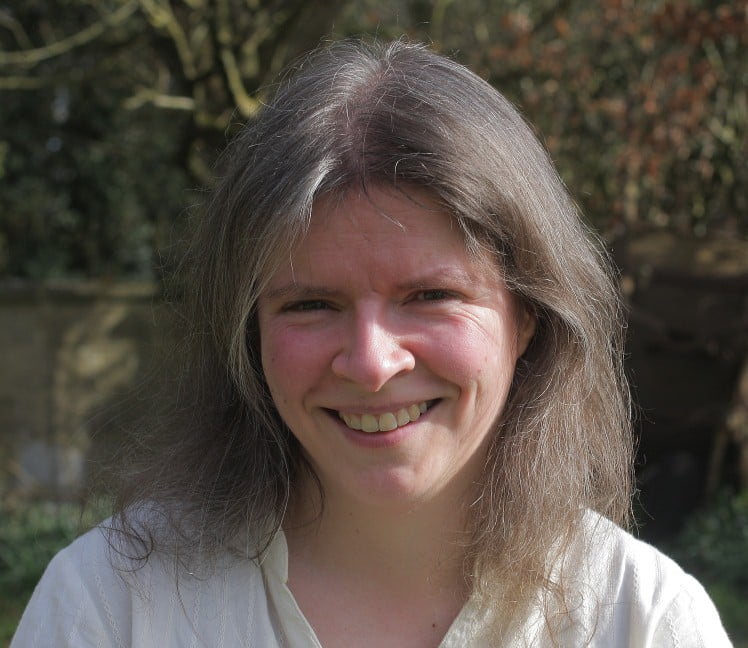
I’m Hilary – I work as an I Ching diviner and teacher, and I’m the author of I Ching: Walking your path, creating your future.
I hope you enjoy the site and find what you’re looking for here – do contact me with any comments or questions.
Clarity is my one-woman business providing I Ching courses, readings and community. (You can read more about me, and what I do, here.) It lets me spend my time doing the work I love, using my gifts to help you.
(Thank you.)
Warm wishes,
Hilary”
Blog
After going one step at a time through the Oracle texts of hexagrams 40 and 59, I thought I'd try the same with Hexagram 48, the Well. This is not the first time I've revisited this hexagram, and probably won't be the last. I suppose that's to be expected! ('They come and go, the well wells.')
I've been reading through the Oracle text again, trying to understand how it unfolds line by line:
'The Well. Moving the city, not moving the well.
Without loss, without gain,
They come and go, the well wells.
Almost drawn the water, but the rope does not quite reach the water,
Or breaking one's clay jug,
Pitfall.'
Moving the city, not moving the well.
井
改邑不改井The well.
Moving the city, not moving the well.
This first statement is starting to sound to me like a riddle. Hold on a minute... we built our city, and we built our well. Both are built, both are ours. How come one of these things can be moved, but not the other?
This might be a good moment to pause and understand what 'moving the city' means. Both in Zhou times and before, Chinese settlements sometimes had to be moved. There are many possible reasons for this: fields losing fertility, creeping drought that drove people south over generations, encroaching hostile tribes. It seems it was generally understood as something required of the people by Heaven.
In the Shangshu, the Book of Documents, you can read the story of a Shang king, Pan Geng, working to persuade his people of the need to move. (Here it is, in Legge's translation: parts 1, 2 and 3.) It's immediately apparent that this move was a major undertaking, one that meant immediate hardship for quite distant long-term gain. The people would take their livestock, sacred objects, weapons and tools, leave their homes and rebuild from scratch - including, of course, digging a new well.
The Oracle text of this hexagram doesn't say 'a city can be moved, a well cannot be moved.' There is a word for 'possible to' or 'capable of' in the Yi, and it's not found here. So it seems to me this is not just a theoretical contemplation of what's possible - it's more likely that it mentions moving cities because a city is being moved. A change is happening, or called for, and it's hard work. Time to understand the difference between all the things that change, and the one thing that doesn't.
So what exactly does it mean to say that the well doesn't move? The city's buildings - heavy timbers on rammed earth walls - aren't going to be moved, either. They, like the well, are left behind.
However, you can rebuild them exactly as they were, wherever you choose. What you cannot move is the place where a well can be dug. A well isn't a building; it's an opening. Minford compares the possible sites for a well - those places where conditions are good and the water table is high enough - to acupuncture points on the human body. I find that a wonderfully rich comparison. The site for the well is there before anyone starts digging.
You can move your whole life - from the royal court to the family pig - but you can't move the contours of bedrock and water table. No wonder Pan Geng had to overcome so much reluctance among his people: as well as moving everything, they were going to have to discover and dig new wells - a whole different kind of work.
This starts to give me a different sense of Hexagram 48 in readings. Wherever you are, you have to find a way to connect to what sustains you. You may have a lot of work to do on the horizontal axis, as it were, moving from point A to point B across the surface - but there is also this vertical axis, the need to rediscover and renew your connection to source, and this is a different kind of thing altogether. More 'moving' activity will not help.
Without loss, without gain
无喪无得。
I don't believe this means that the water level in the well never varies. The water level in a well does rise and fall, and in a hard drought, the well might dry up altogether.
Besides, the words translated here as 'loss' and 'gain' aren't associated with having less or more of something, but with whether you have it at all.
They first appear, together, in the Oracle of Hexagram 2:
'Fruitful in the south and west, gaining partners.
In the east and north, losing partners.'
You could also lose sheep at Yi, lose a horse (don't chase it!), not lose the sacred ladle, lose coins, or a servant, or money and an axe, or the carriage curtain. According to the dictionary, you could lose troops, or livestock, or the support of the people, or your life; the oldest meanings involve mourning at a funeral.
'Gain' might be better translated simply as 'get': the ancient character shows a hand grasping a cowrie shell (used as currency before coins). In the Yi, you might get allies, or honour, or a metal arrowhead.
'Without loss, without gain' seems to me to be a way of offering immediate reassurance for the insecure, uncertain business of moving the city.
I need my well! I can't live without it! What do you mean, I can't take it with me?
No, you can't take the well with you, but that doesn't mean you've lost it. It isn't something you can lose.
It also isn't something you can get. (You can't go to the market and trade for a new well, or become rich by stockpiling wells.)
'This is our house that we built.'
'This is our well that we built.'
And yet it wasn't built in the same way, and we don't own it in the same way.
In readings, all this is a powerful invitation to reflect on what sustains us, what we think of casually as 'ours', without ever owning it at all. Hexagram 48 famously represents the Yi itself. I've often seen it representing mental health and emotional resilience - and most recently (in a reading recorded for a future podcast episode), it stood for someone's family.
Go come well well
往來井井
I love the poetic economy of this line. Go-come, a pair of opposites, two words on their way to becoming one, representing coming-and-going, the passage of time, exchange and relationships. Well-well: 'the well is the well' (Bradford Hatcher); 'the well wells' (me); 'it remains the same well, pure and still' (R.J.Lynn).
This is the perfect, perfectly succinct reassurance. You can't move the well, but there's no need. In all your comings and goings, the well is always present.
However...
汔至
Nearly arrived/reached
亦未繘井
And-also not well-rope/drawing water well
(This is universally translated as 'the rope does not reach the water'.)
羸其瓶。凶。
Breaking the jug. Disaster.
There seems to be a heavy emphasis on how that well-rope is nearly long enough. As a 'cellist, it reminds me of being nearly in tune (another way of saying 'out of tune'): it sounds like someone making an excuse. If you nearly reached the water, you are still just as thirsty.
The broken pitcher is a different failure mode, and perhaps even more frustrating: it reached the water, touched the potential, but can't draw it all the way up into use.
The well is a strange, unique thing: you can't hold it, move it, or lose it; it is always present, underlying and unaffected by all your changes. However, this does not mean 'it's always there for you' no matter what you do. Reaching what it offers is a constant challenge - it's just that the work of reaching it is quite unlike any other work, one at right-angles to regular busy-ness.
A reminder that readings, and the synchronicities that surround them, can simply be fun. Here's a reading, about making both an income and a difference, that certainly is: Hexagram 58, Opening, changing at line 2 to 17, Following:
‘Lakes joined together. Opening.
A noble one joins with friends to speak and practise together.’
The Yi talks in images: hexagram shapes, trigram pictures, sometimes the original forms of the Chinese words themselves, and - most clearly - in its vignettes and stories. When you're just getting started with readings, those are the images you can't miss.
You might ask...
'How to start a conversation to help this decision along?'
And Yi might answer with,
'Coming slowly, slowly,
Confined in a bronze chariot.
Shame.
There is completion.'
(Hexagram 47, line 4)
or,
'Your wheels dragged back.
Constancy, good fortune.'
(Hexagram 64, line 2)
Of course you would read the whole hexagram and the relating hexagram to set this in context, not just your moving line! But this post is just about how you'd engage with the imagery, so I'll zoom in.
What's the first thing to do with an answer like this?
Not 'look up the commentary to tell you what it means.'
Also not 'ask AI to tell you what it means.' I think this can be extra-tempting because while it's hard for the wording of a pre-written commentary to fit all possible questions, if you feed your situation and question into the AI it will spit out a wholly personalised answer. And it will probably do a reasonable job of interpreting the image and turning it into advice about your conversation - AI can be surprisingly good with metaphor.
So why not just go straight to the end result, save a lot of time and effort, and find out what your reading means?
Well - by analogy - if I wanted to transform my cardiovascular fitness, I could train for a marathon. (There is exactly zero chance of this ever happening, but just for the sake of the comparison...) But why not just go straight to the end result, save a lot of time and effort, and buy a marathon completion medal on eBay?
That's not a wonderful analogy (connecting with imagery is actually fun), but hopefully you see what I mean: it would be pointless to get the appearance of the end result without having undergone the transformation. And with Yi, inside the imagery is where the transformation happens.
A good first step is to shelve the whole issue of what the image means, how to make sense of it, and what it's telling you about your question. Instead, you set out to get a feel for it.
Possibly my favourite way to do this is to ask tremendously simple questions about the image itself.
'Coming slowly, slowly,
Confined in a bronze chariot.
Shame.
There is completion.'
What's it like to be confined in a bronze chariot?
Stuffy, I think, and cramped. I can't feel the ground under my feet, I can't stop to take in my surroundings, or speed up and feel my muscles working.
What's a chariot? What's it for?
It's a vehicle. It's to get me to my destination - not necessarily more quickly than walking, but more smoothly and with less effort. I just climb in, get driven there, and climb out again.
What would change about it if you covered it in bronze?
It would be splendidly shiny, polished to a fine gleam, not just an ordinary chariot for everyday journeys. And it would be much heavier, lumbering along slowly, hard for the poor horses to get it moving. It's not going to be nimble; you wouldn't want to use this one on the battlefield.
(This is one place where commentary might come in useful: this isn't a chariot of solid bronze, it's decorated with bronze - 'the conveyance of the aristocrat' according to Stephen Field.)
You'll notice I'm not asking any questions about the conversation I might or might not start, or the decision that needs making. All I'm doing is digging more deeply into the image itself.
Also, you might be noticing that my answers aren't the ones you would give. Two people asking themselves about the same image will come up with different answers, and this is OK - in fact, it's the whole point. Your bronzed chariot might feel luxurious; mine seems to be a bit of a bone-rattler. Mine feels passive; you might be driving. That inner experience each of us has is the reading happening.
And at some point, as you imagine yourself into the image, you will probably have something of an 'aha!' moment.
Even then, this is not your cue to do a 'find and replace' operation on your reading, inserting 'take it slow' in place of the bronze chariot, or the one applying the brakes in 64.2.
I included those two lines because they might both be interpreted as 'take it slow', but they feel completely different. There's the effort of getting the heavy vehicle moving - and there's applying the drag so your wheels don't spin out of control down the bank into the river. If you keep the sound and motion of the chariot, or the smell of the river mud, present to your imagination, then you can take that whole subtle inner experience with you into the conversation. The trouble with taking away only the advice to 'go slow' is that you can understand 'go slow' completely: it makes sense. A vehicle careening down the bank towards the river does more than make sense.
More on this here - and in the 'Connecting with Imagery' workshop, which walks you through more examples and more ways of connecting.
I've been looking lately at something so simple I almost missed it: how the ideas in the Yijing's texts develop, from one phrase to the next. It's easy to look at something like,
'Dispersing, creating success.
With the king's presence, there is a temple.
Fruitful to cross the great river,
Constancy bears fruit.'
and see only a bunch of familiar formulas: the king in his temple (just like in Hexagram 45), crossing the river, constancy being fruitful.
But this is not just a few formulas thrown in and swirled around at random. The ideas here are unfolding, one step at a time, with a coherent internal logic. The king needs to be in the temple before it becomes fruitful to cross the river. And when we receive this oracle, accepting its guidance means slowing down and taking in one thought at a time, so we're in the right place to absorb the next one, and the next. Picking out just the bits we like or that 'make sense' from the outset is not going to work half so well.
An analogy... when I was quite small, my friend Richard and I were busy in the kitchen making a cake, all on our own. I think one of us was in charge of the ingredients and the other in charge of reading the recipe, or something, so we weren't quite clear who should be doing what... but anyway, we got the cake into the oven before we noticed the eggs sitting untouched on the countertop.
Oops.
I'm sure his mum managed to make something from our efforts, because she was a culinary genius, but not even she could have turned it into an actual cake.
Same idea here. If I want my cooking to result in a cake, I should include all the ingredients, and add them in the right order. If I want my reading to result in deep change, I also need to include all its words, add them to the inner mix in the order the ancient recipe describes, and not forget any ingredients.
I've written before about Hexagram 4, and the beautifully elegant way the structure of its oracle text actually enacts what it describes. Here are some more examples...
Hexagram 34, line 3
A curious Change Circle member had a look at this -
'Small people use vigour,
Noble one uses a net.
Constancy: danger.
The ram butts a hedge,
Entangles his horns.'
and asked, why is 'constancy: danger' in the middle of the line? Why not at the end? Or after 'Small people use vigour'? It's dangerous for small people to keep using vigour, it's dangerous for rams to keep charging hedges, but aren't we meant to be realising that the noble one's net idea is better?
(Aside: not every translation has a net here. The word I've translated net is also used as a negative, and so some just say 'the noble one does not'. I do think it's a net, though, because...
- there are other words used regularly as negatives in the Yi (including in 3.3 specifically to mean 'the noble one doesn't do this'). This one, 罔 wang, only appears in one other line, 35.1...
- ...and it has meant 'net, catch, snare, entangle' since ancient times
- 34.3 has a clear parallel construction: 小人用壯。君子用罔. 'Small person uses vigour. Noble one uses 罔.' That sounds as though 罔 is a thing or quality the noble one makes use of.)
That was a good question I'd never really asked before, so I did some looking around. Stephen Field's translation says the noble one uses 'wiles', and his commentary was helpful:
'The counsel indicates that the common man uses strength to get ahead, while the nobleman uses his wits. That the omen is one of danger may stem from the context of the "net" which is the root meaning of "wits, wiles." Those who get ahead by trying to outwit the competition sometimes end up outsmarting themselves.'
I'm in the habit of looking at lines that contrast the choices of small person and noble one as inviting the querent to choose which of these alternative paths to follow, but this line is starting to feel different. Here's how it looks to me now:
If a small person (someone unimaginative, lacking in resources) uses vigour, a noble one with their net/ wiles can no doubt outwit them. But constancy in this pattern is dangerous for everyone involved. Why? The line explains:
'The ram butts a hedge,
Entangles his horns.'
The ram is like the small person - and the hedge is functioning like a net. Now your hedge is damaged, and you need somehow to deal with the furious ram tangled up in it, which is not a good problem to have.
I'd never have thought of any of this if someone hadn't paused to ask, 'Why are the phrases in that order?' and not assumed that the answer was, 'Because this text was cobbled together at random by primitive people who didn't know how to write a book.' As I've said before, I think Yi is more like a symphony than a skip.
Some more examples:
Hexagram 40
‘Release. The south and west are fruitful.
With no place to go,
To turn round and come back is good fortune.
With a direction to go,
Daybreak, good fortune.’
This is one of my favourites for its blunt practicality.
'Yi,' I ask, 'what about doing this?'
'Well,' says the oracle (possibly rolling its eyes), 'suppose you think about it for five minutes? This path you're planning on going down, does it lead to a place you'd want to reach? If not, turn back. If it does, the sooner you start, the better.'
And then I can work myself free from all the 'ought to's and 'what will people think's and sunk costs fallacies I've been using to tie myself in knots, and solve the problem.
(There's a bit more to it than that - especially with the distinction between 'place' and 'direction' - but I've written about that elsewhere.)
Only... why would it bear fruit to head south and west? And why might I need to do that first?
In trigram terms, the south and west are fire and lake: light, warmth and joyful exchange. Between them, in the southwest, is earth. Also, the Zhou people looked south and west to find allies. Combine all these, and the south and west suggests a land of fertile, sunlit fields that friends can work together. The preceding and paired hexagram, Limping, has already got us thinking about the difference between this and north/east, land of chasms, mountains and thunder, which is enemy territory.
And actually, the Sequence of hexagrams - the xugua Wing - gives us the clearest indication of why we should start thinking about Release in the south and west. Go a couple of steps back, with Hexagram 38, Opposing, and how it leads to 39:
'Turning away naturally means hardship, and so Limping follows.'
Turning away from the home (of 37), making yourself an outsider and going it alone, makes life harder. There are moments when this is called for, but by the time you reach hexagrams 39 and 40, you need to change direction. Stop struggling up the mountain in the rain and head for those sunny pastures. Talk to your friends! Fall back, regroup, stop trying to do it all on your own. Step out of your 'solitary hero' story and connect with some real people in the real world.
Once you've done that, turning back or exploring further can be good fortune. I think that's partly because you have thought to ask whether help will be available, but also because getting back into relationship with people, out in those fields, grounds you in reality again. In that context, you can understand whether there's a place to go.
Hexagram 59
One more example - the one I started the post with:
'Dispersing, creating success.
With the king's presence, there is a temple.
Fruitful to cross the great river,
Constancy bears fruit.'
In a time of Dispersing, everything solid is dissolving away. It might feel like having your footing swept out from under you, or just not knowing where you are. What to know about a time like this?
To start with: dispersing, heng. 'Dispersing creates success', or 'dispersing, a successful offering' - a sacrifice offered and received, so you are actively, creatively engaged with the cosmos. (Lots of hexagrams start this way. I'd suggest reading each one as, 'This experience, this quality of time or way of being, can be a way of creative engagement - and here's how...')
For Dispersing to create success, first locate the king in the temple; then it will be fruitful to cross the great river, and hold with constancy to what you know and choose.
Why?
Because the king is not just the one who takes charge (as in Hexagram 55, the opposite of this one), but the embodiment of spiritual connection whose presence means we belong here, we are part of this. With the king's presence, the temple becomes a conduit. Or - when you make the connection between your decision-making self and your sense of the sacred, you can reconnect with the moment, however disorientating. You discover that the energy and momentum of the flood is also yours.
This is another one where reading through the Sequence of hexagrams helps with understanding. After the king assumes responsibility in Hexagram 55, the Traveller steps outside...
'The Traveller has no place where he is accepted, and so Subtly Penetrating follows. Subtly Penetrating means entering in.'
And once you are inside the fabric of things, you celebrate it, and find the deep joy of communion as your world is enlivened -
'Entering in and then rejoicing, and so Opening follows.'
I can imagine Hexagram 58 as the delight of 'thinking' with more than just your own small mind - also with synchronicities, with trees, with human community, as part of a much bigger, free-flowing intelligence.
'Rejoicing and hence scattering it, and so Dispersing follows. Dispersing means spreading out.'
Only then the sense of self and agency, place and ownership, is also all scattered. To avoid feeling completely lost in it all, we need the king in the temple. And with this, it becomes possible to cross the river: pursue your own journey, commit to something perilous, get your feet wet.
A wise client pointed out that this unfolding, from the temple to the river-crossing, mirrors the relationship of Hexagram 1 and Hexagram 2: creative inspiration first, then real-world action. Which is, after all, the core idea of divination itself, that action should originate from spiritual connection. Yuan heng, li zhen - start from the source, create success with the offering accepted, and constancy will bear fruit. There are other hexagrams that unfold in the same way.
In conclusion...
...it works well to start from the assumption that Yi has reasons for saying what it says, in the order it says it in. Skimming past familiar phrases, skipping to the bit that grabs you, you'll gain something from your reading, but you'll also miss a great deal. Instead of the cake you might have enjoyed, you may end up with a rather sad biscuit. Better to let the oracle take you by the hand and guide you, one step at a time.
(If there are other hexagram or line texts you'd like me to explore in the same way, let me know!)
The first thing you're going to notice about this episode is the change of music. The new recording is Kimiko Ishizaka's performance of the 9th of Bach's Goldberg Variations, from her wonderful Open Goldberg Variations project. I hope you enjoy it!
Three readings of mine get a mention in this podcast:
Guidance for the week at Grittleton: Hexagram 51, Shock, changing at lines 1 and 4 to 2, Earth.
How to cope with the bog of 51.4? 4 unchanging - Not Knowing
And advice for the next phase - Hexagram 1, Creative Force, changing at 1, 3, 4 and 5 to 4 again:
I'll explain them all in the episode!
Links I mentioned...
- Mountain above, about the name and trigram picture of Hexagram 4.
- Mark Silver on ignorance as a divine fence
- Grittleton! and also Young Grittleton, where players aged between 11 and 18 achieve extraordinary things.
And not least,
(The photo for this post is of my 'cello with a few of his friends and relations in the corridor at Grittleton.)
So far, I've introduced the idea of ever-flowing constancy, and explored six places where the Yi advises it. There is just one more example:
Don't! 62.4
'No mistake.
Not going past, meeting it.
Going on is dangerous, must be on guard.
Do not use ever-flowing constancy.'
This is clear enough: do not use ever-flowing constancy.
Why not?
Because going on is dangerous, and you need to be on guard. That word, 'on guard', jie 戒, originally shows two hands holding a dagger-axe. It contrasts with the character I translated as 'defends' in the previous line, 62.3, which literally means an earth embankment. So the point of being 'on guard' is that you can move: turn around to face any threat, change direction when you need to.
When you use ever-flowing constancy, you always refer back to your own inner knowing as your guide, and then you are effectively inoculated against outside influence. But the small bird needs always to be aware of everything around it, always alert and ready to react.
The priority now is not to find a way through for your idea, but to stay in one piece. You need to keep checking in with your surroundings, not your inner knowing. (The line changes to Hexagram 15, which 'takes itself lightly' and isn't likely to imagine that its own inner truth - or principles, or sense of identity - is the most important factor.)
In practice, this line tends to mean things - and probably people - are changing, so maybe you need to do the same. Water, of course, never changes its nature and never stops flowing downhill. But then water also can't be injured by anything it encounters along the way.
(Here's an entertaining example of just how alert and responsive this line might be.)
Coda
As always, when I'm looking at all the occurrences of a single phrase, I go on a hunt for patterns. And to start with, I found a great many non-patterns.
Does the wateriness of the character come through? Well, Hexagram 8 is full of water imagery in both its trigrams and the myth of Yu the Great and the floods. Then 22.3 has watery text, and the trigram dui, lake, shows up a couple of times. But 2.7 and 52.1 are quite dry. (Unless you read the Mawangdui manuscript, where apparently the name of Hexagram 2 is written as chuan, 'river'.)
I briefly thought there might be some story-telling with the trigram changes. At 22.3, fire changes to thunder. Then at 42.2, thunder to lake, and at 45.5, lake to thunder. Only then 52.1 changes mountain to fire, and of course 2.7 changed earth to heaven. Nothing to hang your hat on there.
Similarly with the zhi gua of (new hexagram created by) each change. Yes, 2.7, 22.3 and 42.2 all change to rotationally symmetrical hexagrams (1, 27, 61) - but then 45.5 and 52.1 don't. (52.1 changes back to 22, where we've been before.)
The only pattern I can point to - without at all knowing what to make of it - is in the arrangement of the text for the six lines where ever-flowing constancy is a good idea.
There are three phrases it occurs in: 'ever-flowing constancy bears fruit', 'from the source, ever-flowing constancy', and 'ever-flowing constancy is good fortune'. And here's how these three are arranged across the six instances:
- 2.7: bears fruit
- 8.0: source
- 22.3 good fortune
- 42.2 good fortune
- 45.5 source
- 52.1: bears fruit
As you can see, there's a mirror between 22.3 and 42.2: fruitful-source-good fortune: good fortune-source-fruitful. So those six lines make a pattern with rotational symmetry, just like the zhi gua created by the changes of 2.7, 22.3 and 42.2 (1, 27 and 61). (Only not of 45.5 or 52.1, of course...).
And then the one line where this is not a good idea is itself in a hexagram with rotational symmetry, 62, so that this line change destroys the symmetry instead of creating it. Also, where 27 and 61 have yang lines on the outside containing yin lines, 62 is the opposite.
And no, I have no idea what this pattern might mean.
I Ching Community
Podcast
Join Clarity
You are warmly invited to join Clarity and –
- access the audio version of the Beginners’ Course
- participate in the I Ching Community
- subscribe to ‘Friends’ Notes’ for I Ching news